28 May 2015
New Important Archaeological Discoveries at Qal’at Bahrain Site
Known in ancient times as Dilmun, the kingdom of Bahrain is deeply rooted in ancient history, which was further revealed in the most recent discovery by Bahrain Authority for Culture and Antiquities on 28 May 2015. The archaeological expedition team at Bahrain Fort, Qal’at Bahrain, has announced in a press conference that a series of rare and unique archaeological findings have recently been discovered, which would unveil more information about the kingdom’s successive civilizations.
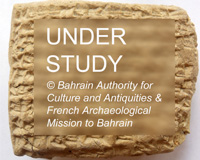
Dr. Pierre Lombard, Councellor of Archaeological Affairs at Bahrain Authority for Culture and Antiquities and Head of the French Archeological Mission in Bahrain, in a press conference at the Bahrain National Museum, has revealed an astounding discovery at Qal’at al Bahrain excavation site. From the many unearthed artifacts two are absolutely remarkable; a square, unbaked clay tablet with cuneiform script, and a figure of lady engraved in a piece of gold found in a clay vessel. The unharmed tablet has cuneiform script on both sides and the edges and dates back to 504 – 503 B.C. or, as the tablet states ‘19th Year of Darius, King of Babylon and the Lands’. The initial report states the tablet is a contract between two people for the exchange of dates, including the names of two witnesses. On the back of the tablet, words were destroyed and it is assumed they are names of the witnesses, city and debtor that were scratched off. The second discovery is a clay vessel and its top, almost fully intact, and inside was sand and a rare piece of gold with a figure of a lady. The research team is still analyzing both discoveries to understand their impact on Bahrain history.
The Qal'at al Bahrain archaeological site (Bahrain Fort), which is an ancient harbor and capital of Dilmun, is Bahrain’s first site to be inscribed on the UNESCO World Heritage List since 2005, in addition to Pearling Heritage Trail, World Heritage UNESCO List since 2012. In 2008 the site museum of Qal’at al Bahrain was opened, sponsored by Arcapita Investment Bank and designed by the Danish architecture firm Wohlert Architecter. The site is a true reflection of Bahrain through the ages, with the remains of successive civilizations and cities neatly piled up on one another in what archaeologist refer to as stratigraphy. The museum is located on the northern coast of the kingdom of Bahrain, and is surrounded by a picturesque seascape and lush greenery that escaped urban encroachment.