04 April 2022
In celebration of the Arabic Manuscript Day, Bahrain National Museum Hosted Two the Bahrain Authority for Culture and Antiquities hosted two lectures on Islamic Manuscripts
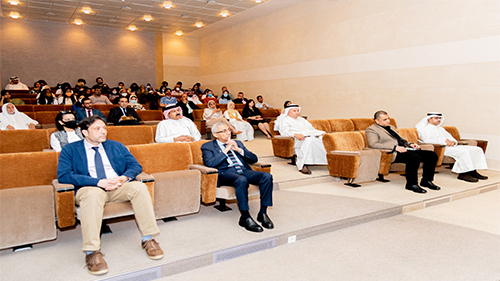
Celebrating the Arab Manuscript Day, the Department of Antiquities and Museums at the Bahrain Authority for Culture and Antiquities organized, on 4 April 2022, two lectures on Islamic manuscripts at the Bahrain National Museum. The lectures were presented by Professor Adel Mamdouh, Head of International Cooperation at the Museum of Islamic Art and Dr. Hamdi Abdulmoneim, Head of Restoration at the Museum of Islamic Art in Cairo, in the presence of His Excellency, the Egyptian Ambassador to the Kingdom of Bahrain, Mr. Yasser Shaaban, Dr. Salman Ahmed Al-Mahari, Director of Antiquities and Museums Department at the Bahrain Authority for Culture and Antiquities, as well as a number of people interested in cultural affairs.
First, Dr. Hamdi Abdulmoneim shed light, during his lecture entitled "Principles of Conserving Islamic Manuscripts", on the most important things that must be taken into account before embarking on the process of restoring manuscripts, and what this requires of an extensive study of the materials from which these manuscripts are made. These are usually of plant or animal origin, he said, stating the reasons of their decay and damage, as he explained that the causes of damage to manuscripts are many: self-chemical damage, chemical damage by light, chemical damage by heat, chemical changes accompanying humidity, and atmospheric damage effects. After that, Dr. Hamdi Abdulmoneim shed light on the stages of treatment and restoration of manuscripts, which begin with physical examination and chemical tests softening and flattening pressing and drying, cleaning, practical applications for paper cleaning, pH-neutralizing treatments, hardening, and sustainability. During his lecture, Dr. Abdulmoneim presented examples of manuscript restoration works in the Museum of Islamic Art in Cairo, and it was the first example of restoration work. It was the first model for the restoration of the "Papyrus", where it explained the stages of work before the restoration, the stages of treatment, the method of preservation inside the warehouses, and then highlighted the work of restoring an Iranian Qur'an made of paper, as it revealed a set of pictures of the Qur'an before the restoration, in which the effects of damage are evident on the cover of the Qur’an and its contents. Then, Abdulmoneim talked about the stages of treating the Qur’an and the final image that it became after the restoration, and in the last model, he explained how to restore a Qur’an made of leather and written Samarkand Kufic Quran, or the Othman Quran or Qur’an of Othman way, using scientific means.
During the second lecture entitled "Masterpieces of Manuscripts in the Museum of Islamic Art in Cairo", Professor Adel Mamdouh began his presentation with a simplified explanation of the Museum of Islamic Art; the name was changed from House of Arab Antiquities to the Museum of Islamic Art. Mamdouh also explained the importance of the archaeological collection contained in the museum and the specificity of the decorative element within its official logo Mamdouh reviewed a set of photographs showing the archaeological holdings in the main halls of the museum, including: manuscripts of supplications, manuscripts of the shape of the sanctuary and the movement of urban development in the vicinity of the sanctuary, in addition to that, images of manuscripts describing daily social life such as marriage contracts, processions, instruments of rapture and music, were shown. Sports, education, education license, illustration of the scientific gathering in the Ottoman era, student specialization, a picture of a medical prescription from the Abbasid era, a manuscript for the anatomy of the body, astronomy, binding, a model with normal manuscript skin and others.
In addition, the Bahrain National Museum has dedicated the content of the “Piece of the Month” for the month of April to display two rare manuscripts, which are the two parts of “Tafsir al Jalalain “Interpretation of Al-Jalalayn” is a rare original manuscript classified within the sciences of the Holy Qur’an. Al-Jalalain is an abbreviation of the two famous Islamic scholars, Jalal al-Din Muhammad ibn Ahmad al-Mahali, who died in 864 AH, and Jalal Abdul Rahman ibn Abi Bakr al-Suyuti, who died in 911 AH. It is one of the most famous interpretations of the Holy Qur’an in terms of brevity and abbreviation. Al-Mahali died before he completed the rest of the interpretation, so Al-Suyuti completed it after his death.
It is noteworthy that the Arabic Manuscript Day is an annual regional awareness day on 4th April of each year, sponsored by the Arab Organization for Education, Culture and Science (ALECSO) in the League of Arab States, and celebrated by Arab member states, as well as by Islamic and foreign bodies sometimes. Indeed, the concerned authorities with regard to Arabic manuscript heritage participate in the message of spreading Arab heritage awareness in an Arab event. Indeed, Arabic manuscripts are celebrated as the vessel that carried the intellectual and cognitive heritage of a civilization that spanned fourteen centuries.