21 March 2022
Abu Saiba’s Archaeological Excavation Results Revealed
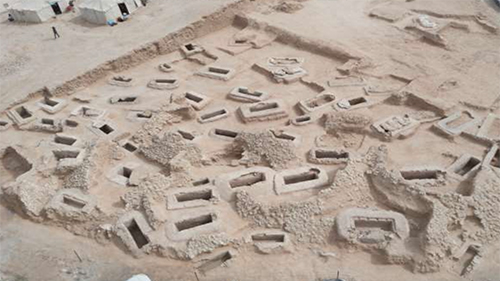
The Bahrain Authority for Culture and Antiquities held an open day at the archaeological site of Abu Saiba, on 21 March 2022. During this event, which was attended by a large number of residents and those who are passionate about history and antiquities, Bahrain culture Authority announced the results of the archaeological excavations carried out by the French archaeological team, while the audience listened to a detailed explanation about the history of the site and the recent archaeological discoveries made at the site.
Indeed, the French archaeological team from the Louvre Museum - Paris, headed by Dr. Julien Cuny, resumed the sixth season of archaeological excavations at the Abu Saiba archaeological site, on February 16, 2022, with the participation of French and Bahraini archaeologists.
Dr. Salman Al-Mahari, Director of Antiquities and Museums, indicates that this event is a continuation of the initiative launched by BACA several months ago, entitled "Community Partnership/Friends of Antiquities", the aim of which is to spread archaeological awareness in the local community and to involve them in preserving the National Heritage. Dr. Al Mahari added that the aim of today's gathering event, held at the Abu Saiba site, is to get closer to the archaeological site’s neighboring residents, making them feel more familiar with the history of the site, its components, and its importance. This would certainly contribute to its preservation and safeguard and to keep them updated and informed about the efforts made by the Authority of Culture and Antiquities with its partners with regard to these historical landmarks.
In addition, Al-Mahari asserted that BACA will continue its efforts to uncover the archaeological treasures buried, artefacts that reflect the richness of Bahrain’s civilizational heritage and the prosperity of its people throughout the ages.
Since 2017, the French Archaeological Mission in Bahrain has been engaged in a research project at Abu Saiba, a major necropolis from the Tylos archaeological period of the island. Moreover, the site of Abu Saiba is a hill tomb dating from the Middle Tylos period (50 BC - 150 AD), with a maximum diameter of 70 meters, and a height of 4 to 4.5 meters. Indeed, since 2017 until today, about a third of the total area of the mound has been uncovered, and 93 burials have been identified. During this year 2022, 23 new tombs were discovered, while 11 were completely excavated, and out of these 11 burials that were excavated, 3 were intact, the others were deliberately looted and robbed, most likely in Antiquity, though they still yield sometimes interesting archaeological and anthropological materials and data.
Julien Cuny, Head of the French Archaeological Mission Team, also asserts that the main goals and objectives of excavation at the Abu Saiba site is to study the material culture of the people of Bahrain during the Tylos period, looking for accurate information on chronology, the different materials and manufacturing process, funerary rituals, and trade relations. While the anthropological study provides information on age, gender, health conditions, and sometimes the funeral connotations and symbolic rituals. During this year, Julien adds, an interesting intact tomb was excavated. The body was laid on its back in a built burial chamber covered with stone slabs. The burial chamber was not filled with sediment, as is usually the case when tombs are looted. The skeleton was well preserved and in good conservation conditions. The dead is a male over 50 years old, who was buried with few things: only a bowl placed in his right hand and parts of an animal, possibly a chicken, as an afterlife offering.
Usually the dead was buried with his belongings, some of which were found intact. They were mostly pottery vessels, usually glazed green, such as plates, small bottles, or small amphorae. Sometimes, glassware is also found, but it is very fragile and brittle and often they disintegrate or break. Fragmented pieces. Indeed, one of the exciting discoveries this year is the discovery of the grave of a baby about a month old, buried within a stone-built tomb, accompanied by his funeral objects, which are a group of pearls and beads, a human-shaped doll made of bone, as well as a small alabaster bowl, which indicates that this tomb is A child from a socially privileged family.
In addition, among the archaeological discoveries during this year’s season to be mentioned the many small bone pieces in two tombs. They originally adorned wooden chests whose wood has vanished over time, breaking up loose, split, and detached bone fillings.
A unique pottery effigy depicting a woman wearing elegant, draped clothing, clear body parts but her head is missing was also one of the unique discoveries this year. Meanwhile, a dice was found for the first time in tombs dating back to the Tylos period.
It was noted that the most common funerary ritual in this cemetery is to place an inverted vessel over the top of the tomb and contains ashes resulting from the burning of an unidentified substance. Then the bowl and the rest of the tomb were covered with sand and gravel to form a small mound. This custom was common in the tombs of Tylos in the various regions of Bahrain.